
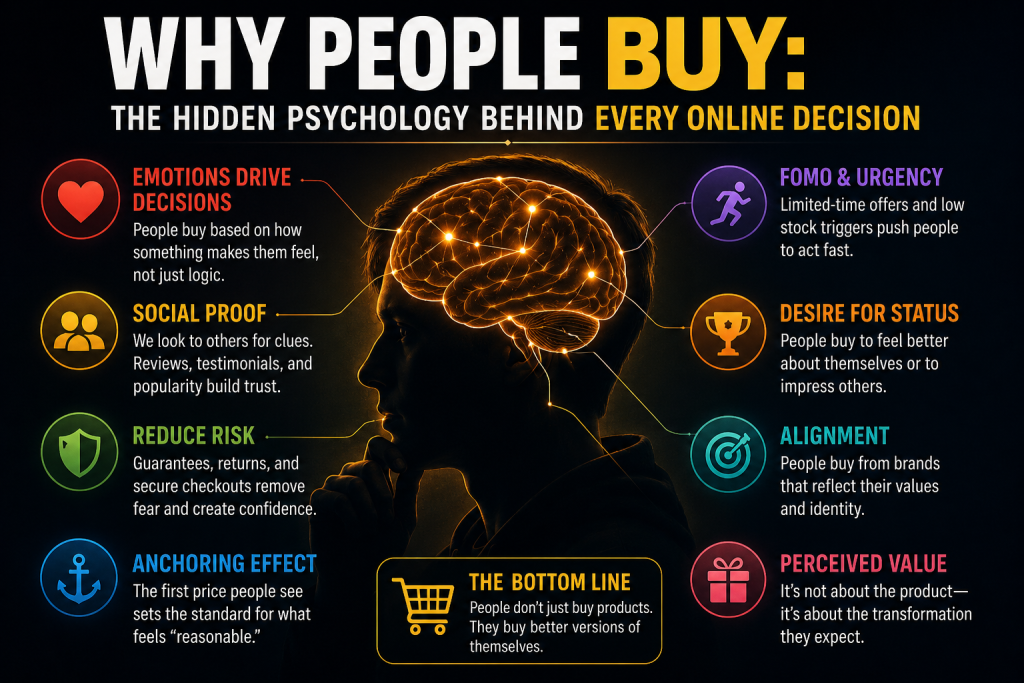
Long before clicking on “Buy Now,” a myriad of unseen factors will be driving their decision-making process. Knowing these factors is the true calling of a digital marketer.
Marketing books may state that it is all about reaching and frequency. But they won’t be telling the whole truth. The truth is that consumers decide to purchase online based on psychological motivations, not marketing strategies. At Novaria, we discovered that it was the companies who were knowledgeable about their clients’ psychology that beat the competition.
Let’s take a look at what consumer behaviour science has to say.
The Trust Gap is Real, and It’s Your First Battle
Buying online is an act of faith. The buyer cannot touch the item, see you in the face, or visit your office. Every aspect of your virtual presence—your website speed, your ratings, your About Us page, your Instagram feed—is building trust or breaking it down. You must earn your customers’ trust before selling anything to them.
Put your effort into building social proof: testimonials with pictures and names, case studies that show results, and UGC.
Loss aversion beats desire every time
Daniel Kahneman, a psychologist, conducted experiments demonstrating that people experience twice the level of pain when losing an equivalent amount compared to joy when obtaining the same. These findings have significant consequences for the way you write your copy. The statement “Don’t miss out on 30% savings” works much better than “Get 30% off,” even though the deals are identical.
Losing something rather than gaining something else is a much more emotional message.
Decision Fatigue is killing your conversions
Too many options freeze people up. If there are ten options on a landing page or forty on a product page, the first impulse is always to not do anything at all. Simplification is the key to conversion. Point your visitor towards one single action to take next. Strip away all other distractions. Make the ‘right option’ painfully obvious.
The world’s greatest e-commerce companies live by the mantra of removing friction rather than adding more features. Every additional click, every additional field, and every additional decision is another opportunity for people to bail out.
People Buy Identities, Not Just Products
No one purchases a luxury watch to see what time it is. No one buys organically grown produce just because of the health value it holds. People purchase items that speak volumes of their personality. Your advertising should focus on personality, rather than the practical use of the item. What statement does purchasing your product make about the consumer?
Market yourself through the success story that you can make of the consumer.
Timing and context change Everything
The same ad presented to the same individual at various times may end up yielding totally different outcomes. Re-targeting individuals who have just been to your pricing page would be infinitely more effective than going after cold prospects. Contextual advertising, which involves presenting the right message to the right consumer at the right point of their customer’s journey, remains one of the most leveraged skills in digital marketing.
This should be reflected in the way you create your marketing funnel; awareness, consideration, and decision each call for something different.
Final Thoughts
Not only are great digital marketers masters of technology but also students of human psychology. The more you know about why people make decisions, the better you’ll be able to connect and communicate. Your copywriting will resonate, your user experience will eliminate any friction, and your marketing campaigns will be seen not as advertisements but perfectly timed conversations.
This is the mindset behind our work at Novaria. Once you know what makes your customers tick, there’s no need for loudness; it’s all about showing up at the right time with the right message.